AI for law firms
California’s 2026 AI Guidance: Law Firms Need to Govern What Agents Can Do
California law firms now face two distinct AI developments. On 14 May 2026, the State Bar approved updated practical guidance covering generative and agentic AI. On 30 September, California enacted SB 574, which introduces additional statutory requirements from 1 January 2027. The first explains existing professional duties in light of new technology; the second changes the legal requirements themselves.
For a managing partner, the distinction matters less than its practical implication. Firms can no longer assess AI solely by whether the generated answer looks right. They need to know what an AI system can access, what actions it can take, and which decisions remain with a lawyer.
The change is from AI outputs to AI actions
Imagine an AI assistant preparing a litigation chronology. A prompt-only tool summarizes a set of documents selected by an associate. An agentic version may search the matter repository, gather additional files, update its chronology when new material arrives and flag inconsistencies. Both can save effort. The second also has continuing access, discretion over retrieval and opportunities to act without a lawyer watching each step.
California’s revised Practical Guidance expressly discusses agentic systems: tools that plan, select resources and execute multistep tasks without immediate human prompting. It says that autonomy does not alter the lawyer’s duties. A lawyer must understand the extent of the system’s autonomy and maintain meaningful supervision, verification and independent legal judgment.
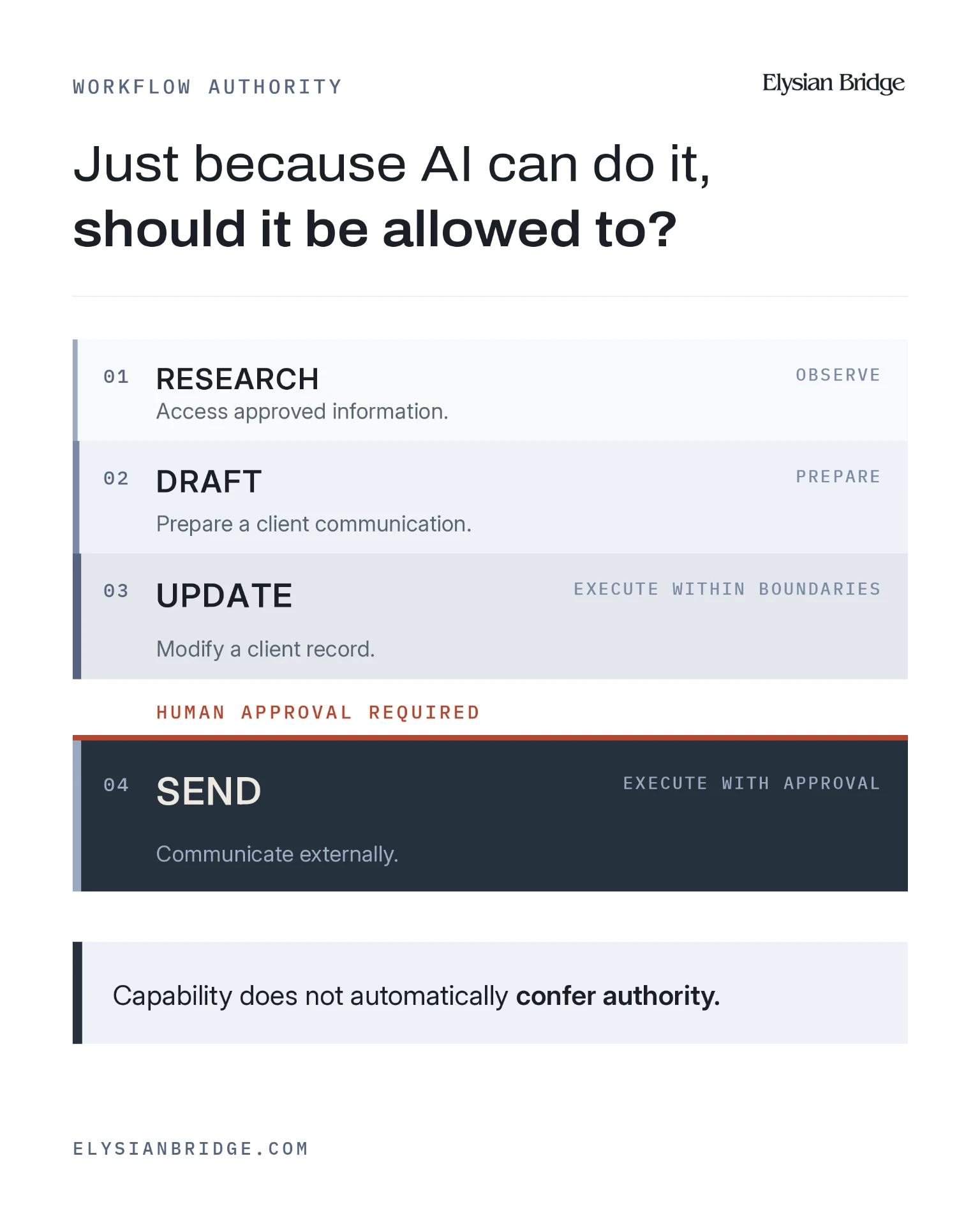
That translates into a concrete design principle: the tool may assemble and surface evidence, but the lawyer must own the legal conclusion and approve consequential work product. A system should not autonomously give legal advice, file pleadings or transmit confidential client material without appropriate safeguards and human review.
What to check before expanding an agent’s permissions
Start with data access. Which clients’ files, messages, calendars and knowledge bases can the agent reach? Can it move information between matters? Does the vendor retain prompts or use them to train a model? The 2026 guidance cautions against relying on general security claims and calls for diligence appropriate to the system’s access, storage and disclosure risks.
Next, examine the review step. If the agent drafts a client update, what exactly is checked before the communication leaves the firm: factual claims, legal propositions, cited authorities, client restrictions and recipient details? A nominal “human in the loop” is insufficient if nobody has the time, source material or responsibility to perform a meaningful check.
Then examine the economics. The guidance distinguishes hours actually spent on AI-assisted work from hours a task might previously have required. It also discusses when general AI subscriptions resemble overhead and when particular client charges or markups need fee-agreement treatment and consent. Faster production should not create an opaque bill.
Finally, record when the client should be told. Whether disclosure or informed consent is needed depends on the tool, the matter, the risk, the significance of the use and any client instructions. An engagement-letter statement about ordinary AI practices does not replace a specific conversation where one is required.
SB 574 is a separate compliance milestone
SB 574, Chapter 858 of the 2026 statutes, was approved on 30 September and takes effect on 1 January 2027. Among its requirements, it prohibits delegating the practice of law to generative AI, restricts placing confidential or other nonpublic information into systems without the specified access protections, calls for verification and correction of AI-generated material, and addresses personal verification of citations and disclosure of AI use in court submissions.
The statute’s wording and implementation merit careful legal review, particularly where the application of disclosure requirements is not yet settled. It should not be confused with the State Bar’s guidance or with proposed ethics rule-comment amendments that have not been adopted. California firms should monitor relevant court rules and further clarification.
A useful leadership test
Choose one AI-assisted workflow and trace a real result from input to final approval. Take a draft client update as an example. Can the firm identify the approved sources, the systems accessed, the agent’s permissions, the reviewer, the checks performed and the final authorization? Now introduce a failure: a file from the wrong matter, an invented authority or an incorrect recipient. Would the process reliably stop it?
If these questions are difficult to answer, the next investment may not be another model. It may be workflow design, access controls and a review process that people can repeat. Elysian Bridge helps law firms make that transition from individual AI use to governed organisational capability. Explore our AI for Law Firms approach.
Frequently asked questions
Is California’s May 2026 AI guidance binding law?
The Practical Guidance explains how existing duties apply to AI; it does not by itself enact new statutory requirements. The separate SB 574 statute takes effect on 1 January 2027, while existing professional obligations already apply.
Does the revised guidance ban agentic AI?
No. It places emphasis on understanding a system’s autonomy, limiting its access, preserving independent judgment and putting supervision and review around consequential actions.
Primary sources
- State Bar of California: 2026 Practical Guidance for Generative Artificial Intelligence (PDF).
- State Bar of California: Ethics & Technology Resources, May 2026 guidance update.
- California Legislature: SB 574 bill text and status; chaptered 30 September 2026.
- California Lawyers Association: analysis of SB 574, 27 October 2026.
Let’s have a conversation.
Book a conversationGet the next insight
Catch up on AI in five minutes a week.