AI for law firms
ABA Opinion 512: Buying an AI Tool Is Not the Same as Supervising Its Work
A law firm can approve a generative AI product for every office and still not have answered the harder question: how will it know whether work produced with that tool meets its professional standards? ABA Formal Opinion 512 brings that gap into view.
Issued on 29 July 2024, the opinion explains how existing duties under the ABA Model Rules apply when lawyers use generative AI. It doesn’t prohibit the technology, and it isn’t a nationwide statute. It does make clear that buying a tool, or letting individual lawyers experiment with one, leaves the duties of competence, confidentiality, communication, supervision, candor and reasonable fees exactly where they were.
What the client relies on
Take a hypothetical associate who uses AI to prepare an initial contract comparison. The tool finds ten apparent differences and writes a polished summary, and the client receives a conclusion. The client never sees the prompt. They are relying on a few things having happened: the documents were authorized for use, someone checked the comparison and caught any material omissions, the responsible lawyer approved the conclusion, and the fee was appropriate.
Behind that example sit three separate operating decisions.
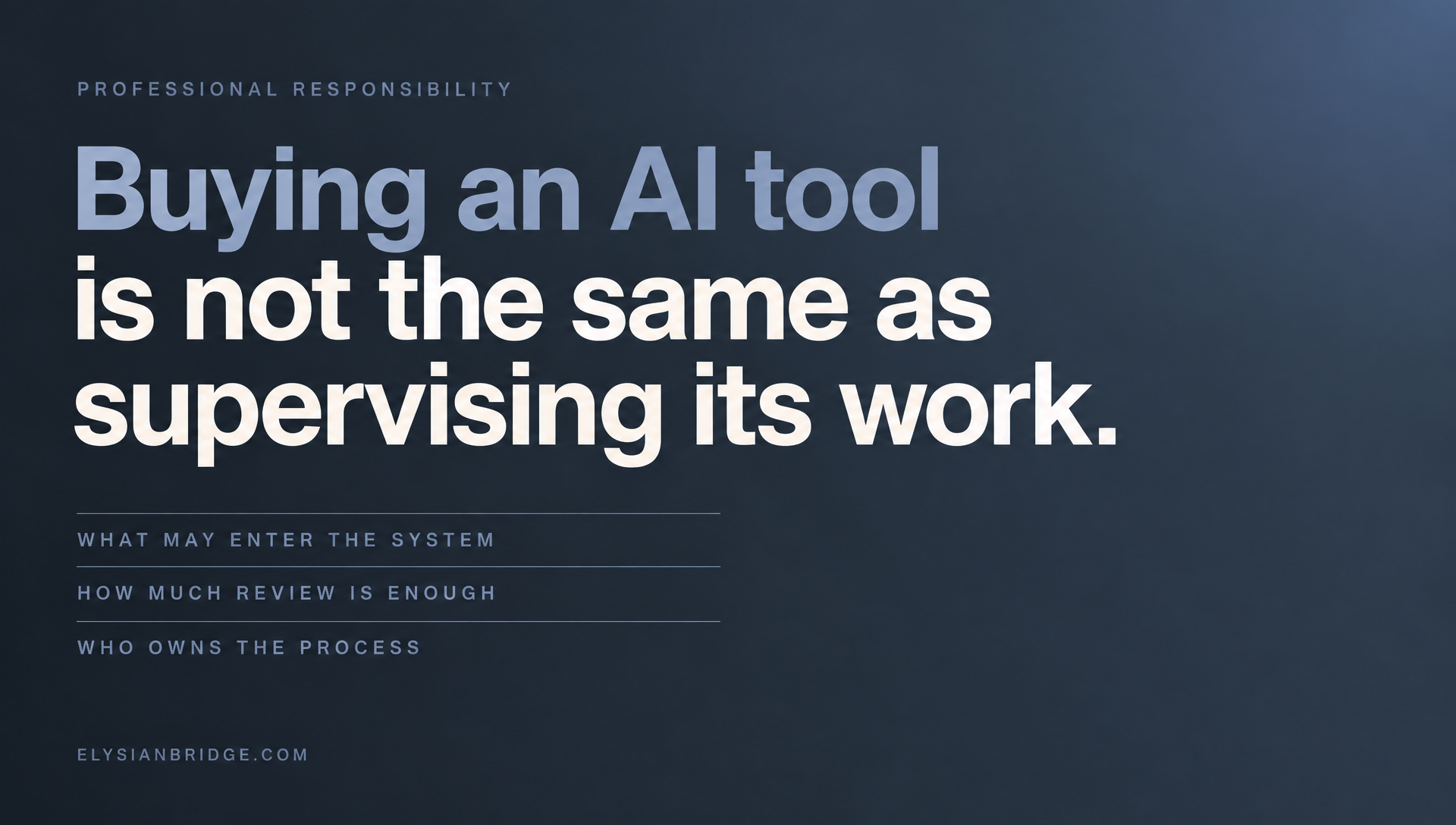
The first is what may enter the system. Confidentiality analysis covers the vendor’s access, retention and training practices, along with the relevant security controls. Depending on the arrangement and the risk of disclosure, the firm may need the client’s informed consent before entering matter information. A vendor’s claim of enterprise security doesn’t tell you how the data actually flows, and that flow is what the firm has to understand.
The second is how much review is enough. Opinion 512 ties competent AI use to a reasonable understanding of the tool’s limits and to appropriate independent review. An internal administrative summary may need lighter checks than a legal proposition going into a brief. A polished answer can still be wrong, and so can one with citations. The lawyer remains responsible for what goes to a tribunal and for the advice the client receives.
The third is who owns the process. Lawyers must appropriately supervise associates, staff and service providers. If a firm gives employees AI access without defined approved uses, verification expectations or an escalation route, the quality standard may vary from desk to desk, and fixing that falls to management as much as to IT.
Two points many AI policies understate
Client communication can’t be reduced to a single yes-or-no rule. Opinion 512 doesn’t require notice of every incidental use of AI. It identifies circumstances in which a client should be informed or asked for consent, including when the client asks, when AI use materially affects the representation, and when the risks call for informed consent. Engagement terms and outside counsel guidelines may add requirements of their own.
Billing needs the same care. The opinion rejects charging for hours not worked just because an AI tool produced a draft faster than a person would have. Time spent meaningfully reviewing and editing the output, and taking responsibility for it, is still work. AI expenses charged separately have to be assessed under the applicable fee rules and the engagement terms, and ordinary subscription costs aren’t automatically disbursements.
Turn an ethics opinion into an operating test
Asking employees whether they are “using AI responsibly” won’t tell you much. Pick one regular workflow and ask for a traceable example. What information went in? What came out? What source check took place? Who signed off? How was the work billed? If the answers depend on interviewing the one person who ran the tool, the firm has adopted AI without standardizing how it’s used.
This test is our suggestion for managers, not a requirement of Opinion 512. The opinion supplies the professional duties, and each firm decides how to build them into its technology and daily work. Elysian Bridge helps firms design the workflows, controls and oversight that make those decisions repeatable. Read more about our AI for Law Firms work.
Frequently asked questions
Does ABA Formal Opinion 512 ban ChatGPT or other generative AI tools?
No. It addresses the ethical obligations that continue to apply when lawyers use generative AI. Whether a particular tool suits a particular task depends on the circumstances and the governing requirements.
Is Opinion 512 binding on every US lawyer?
No. It interprets the ABA Model Rules, and states and courts apply their own rules and guidance. Firms should check every applicable jurisdictional and client-specific obligation.
Does an AI policy alone satisfy the opinion?
A policy may help, but the duties concern what lawyers actually do. Putting them into practice may involve tool review, training, supervision, verification, client communication and billing controls.
Primary sources
- American Bar Association: Formal Opinion 512, Generative Artificial Intelligence Tools, 29 July 2024 (PDF).
- American Bar Association: announcement and overview of Formal Opinion 512.
Let’s have a conversation.
Book a conversationGet the next insight
Catch up on AI in five minutes a week.