AI value
AI productivity is not the same as AI value.
The first wave of enterprise AI adoption has made productivity the most visible measure of progress. That's understandable: time saved is easy to see, individual users can describe it immediately, and leadership teams can point to faster drafting, research, summarization or analysis as evidence that the technology is working. A 2026 survey by McKinsey reflects that momentum, with eight in ten respondents reporting that AI had improved their productivity, yet only 37% attributing at least some EBIT impact to AI use. The gap between those two numbers does not suggest that AI is failing. It suggests that productivity and enterprise value sit at different points in the same chain.
That distinction matters because a task can become faster without the completed work becoming meaningfully better, cheaper or more reliable. If AI reduces the time required to produce a first draft, the benefit is real, but it is only the beginning of the economic calculation.
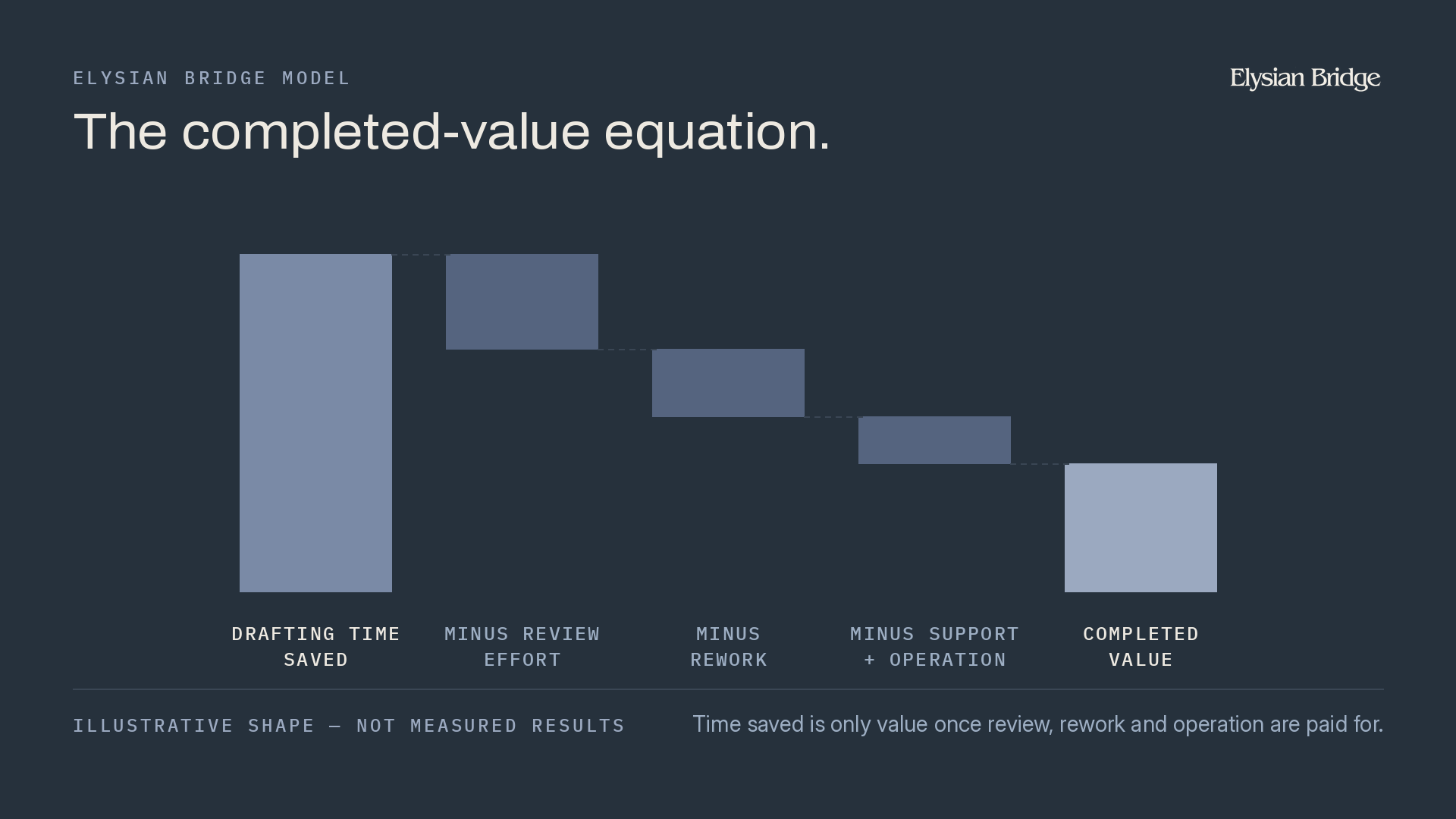
We use a simple way of thinking about what remains:
- Drafting time saved
- - minus review effort
- - minus rework and repeat attempts
- - minus support and operating effort
- - equals completed value
The useful question is therefore not simply whether AI accelerated the task, but whether the workflow delivered a better completed outcome once the full cost of getting there is understood.
This becomes more important as the systems themselves become more capable. Stronger models can perform more substantive work, connect to more information, operate more software and continue tasks across handoffs, increasing the distance between an initial instruction and its eventual consequence. The framework we've developed describes this progression from work that remains “on the page,” through connected systems and delegated activity, to actions that can change a record or create an external disclosure. The governance implication is slightly counterintuitive: as models make fewer mistakes, the significance of the remaining mistakes can increase because the systems are able to do more with them.
For leaders, that changes the economics of review. If an organisation can produce AI-assisted work at a much greater rate, review capacity can become the new constraint, particularly where the work requires professional judgement rather than a simple factual check. In legal and professional services, a reviewer may need to understand the original source, see the proposed change, identify unresolved questions, challenge the reasoning and, where necessary, stop dependent work from continuing. Review therefore needs to be designed as part of the workflow rather than treated as a final quality-control step added after the AI has finished.
There is also a difference between saying work was checked and being able to show what happened. For higher-value or higher-risk workflows, the evidence should be proportionate to the consequence of getting the work wrong. That does not mean logging everything forever; more evidence is not automatically better evidence. It means retaining enough to reconstruct an important decision when required.
Our test is straightforward: could someone later understand what the AI used, what it changed, who made the decision and what happened next?
This is where productivity metrics can become misleading if they are allowed to stand alone. A workflow that saves ten minutes hundreds of times a week may create more value than an impressive automation used twice a quarter, while a process that appears to save hours may prove uneconomic if every output requires lengthy senior review or repeated correction. The measure therefore has to follow the work. In billing, that may mean defects, cycle time, realization and rework; in business development, response time, opportunity quality or conversion; in knowledge work, how quickly someone reaches a trusted answer and how often that answer needs correction.
There is also a human consequence that is easy to miss when the focus stays on throughput. If AI increasingly performs the first pass of research, drafting and analysis, junior professionals may encounter fewer of the moments through which judgement is traditionally developed. The answer is not to preserve inefficient work for its own sake, but to design review and learning deliberately, so that people still have to explain their reasoning, compare alternatives, challenge the system and understand why a decision was made. As AI produces more work, organisations need to protect both the capacity to review it and the conditions in which professional judgement continues to develop.
For us, this leads to a fairly simple conclusion. AI productivity is useful, but it is not yet the same thing as AI value. Value emerges when a workflow produces completed, reliable work more efficiently; when the required review effort is understood; when the evidence is sufficient for the risk involved; and when the outcome can be measured in terms that matter to the organisation.
That’s a less glamorous conversation than showing a model producing something impressive in seconds, which, by the way, we also do. It is also much closer to the conversation that determines whether AI becomes a durable operating capability rather than another layer of software.
The question we increasingly ask is not “How much time did AI save?” but “What became better once the work was actually finished?”
Let’s have a conversation.
Book a conversation